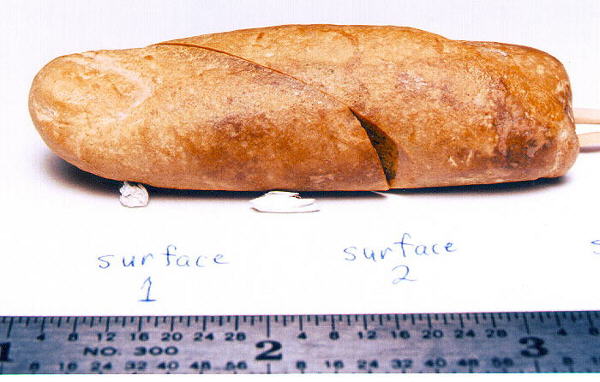
From Baugh's CEM Website
| E-mail author | Paluxy Home page |
|
|
| Alleged Cretaceous finger
From Baugh's CEM Website |
|
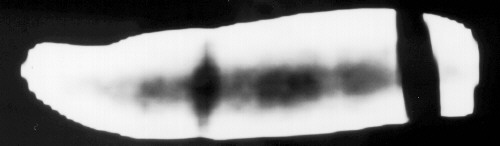
| CAT scan of alleged Cretaceous finger (from Baugh's web site) |
In view of the lack of rigorous evidence on the origin of the "finger," it is almost moot whether it is a real finger fossil or not. However, since it would be an interesting fossil if real, regardless of its alleged out-of-place status, let us briefly examine this issue. Despite Baugh's insistence that it is virtually identical to a real human finger, it actually shows a number of anatomic inconsistencies. The supposed finger-nail is narrower on the proximal than distal end, and there is a furrow running lengthwise along the supposed top of the sepcimen which is not a normal feature of a real finger. It also shows no indication of knuckles, nor any evidence of trauma at the proximal end. One might ask how the finger became separated from the rest of the body without such indications.
|
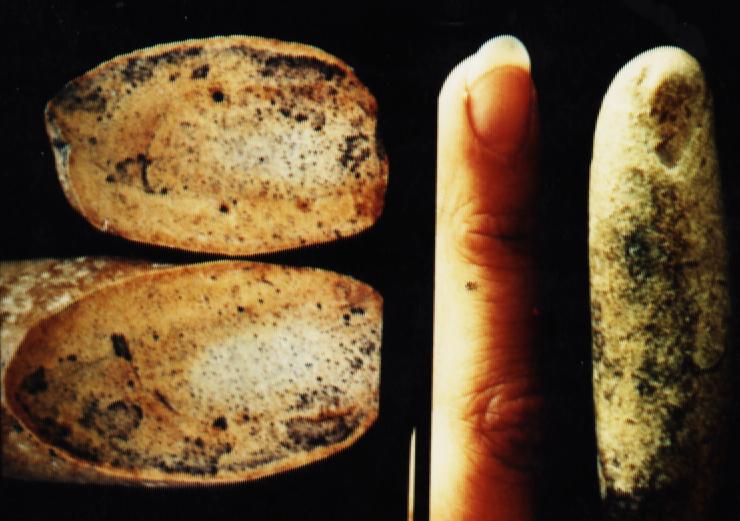
| Cross section of the "finger" (photo link to www.biblebelieers.org website) |
The lack of clear bones is also evident in the cross sections of the finger, which show some ill-defined concentric bands, but no distinct boundaries. The innermost, lighter-toned region (presumed to be a bone) also is oriented much closer to one side than the other, rather than being more centered as would be expected for a bone. Baugh and others[4] have claimed that the tiny dots represent bone pores, but they extend well beyond the area assumed to be bone, and thus seem to refute rather than support the bone contention. It seems more likely the tiny structures represent particles of contrasting sediment or microfossils (perhaps osctracodes and/or forams), but evidently the finger proponents have not done the rigorous microscopic work needed to conclusively identify them.
|
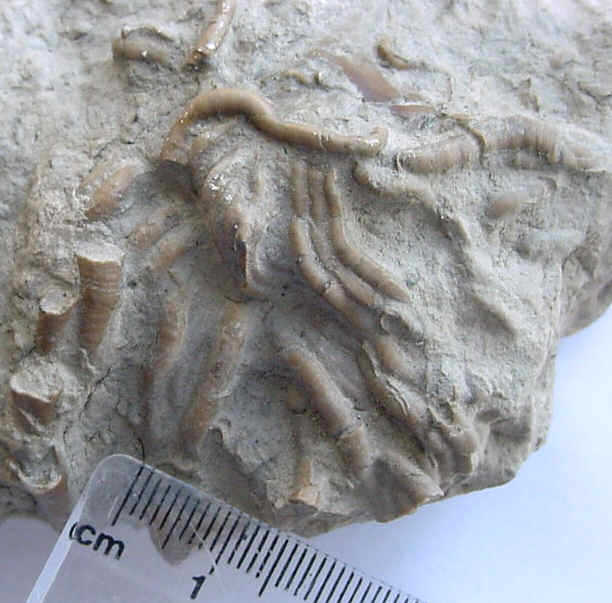
| Serpulid worm tubes, Cretaceous,
Glen Rose Formation, Texas |
Another consideration is that such soft-tissue preservation is not known for other Cretaceous fossils of Texas. Fossils are abundant in Texas. However, almost all are impressions, steinkerns (natural molds), hard-parts that are partially or entirely mineral-replaced. Evidently none include vertebrate soft tissue preservation. Whatever the factors of taphonomy responsible for this, it seems unlikely that a single finger would be preserved with all flesh and bone pristinely mineralized, and not even scrappy remains of flesh from other mammals, reptiles, fishes, amphibians, or invertebrates that occur in Cretaceous rocks in Texas. Baugh's web site states, "soft tissue is fossilized with remarkable detail when the organism is rapidly buried soon after or before death." As alleged evidence of this, Baugh shows a photograph of supposed "well-preserved worm fossils" from the Glen Rose area.* However, the photo does not show fossilized worms, but rather surpulid worm burrows--an important distinction, as the latter consists of mineralized tube-like linings of sediment mixed with worm secretions, not soft tissue. Indeed, Baugh's statements about the ability of rapid burial to preserve soft tissue beg the question of why then there are not countless examples of soft tissue preservation from humans, other mammals, reptiles, dinosaurs, and other creatures from local strata. After all, in Baugh's model of earth history, all of these organisms lived together, and then died together in a single Flood a few thousand years ago.
In view of the above considerations, as well as the consistent lack of human remains throughout Mesozoic formations, Baugh's claims about the "finger" are questionable at best. As to what it really is, no consensus has yet developed. Some observers have suggested that the specimen may be an invertebrate burrow or a cephalopod fossil. While I see little evidence of the latter, it could be an burrow infilling. It also has the general appearance of a crustacean carapace, though no demonstrable association with known crustacean taxa has been made. Alternatively, it could just be an elongate stone or concretion that happens to resemble a finger. If one looks around a pile or rocks long enough, one can find all sorts of "sports of nature" which resemble familiar objects--much like finding faces in the clouds. Perhaps a more conclusive assessment of what the object really is could be made if Baugh allowed experts on Texas geology and paleontology to study it. One would think he at least would want to confirm whether or not its lithology is consistent with known Cretaceous rocks of Texas, but as of this writing, evidently he has not done this. Evidently his associate David Lines doesn't think this is necessary, as concludes his article on Baugh's website with two unfounded assertions: "This fossil is obviously human in its appearance, both inside and out. But it was found in Cretaceous rock."
As with all extraordinary claims, the burden of proof is on those making the claims, not on those questioning them. Baugh and other promoters of the "fossilized finger" have not conclusively established that it is a real fossil. Nor have they demonstrated a clear association with an ancient formation, undermining its possible value as an out-of-place object. Without this evidence, the object is merely a curiosity, not a reliable out-of-place fossil.
Oct. 2012 Update. Earlier this year I was received an email from a woman who said she gave Baugh this finger-like stone object years ago, on the condition that he return it soon. She said he has since refused to give it back, and wanted to know what recourse she had. I advised her to seek legal advice, but that to my way of thinking, if someone refused to return a borrowed item, it is tantamount to theft.
* Baugh has since removed the reference to fossilized worms from his web site, but David Lines' article there, at http://www.creationevidence.org/index.php?option=com_content&task=view&id=28, still shows a photo of fossilized worm tubes, with the ambiguous and misleading caption: "Under rapid-burial conditions, the individual cells in an organism can mineralize and harden individually, preserving microscopic details of the original plant or animal." However, the photo does not show what the caption implies. The tube-like structures are not cells or any other parts of a fossil organism, but the harden remains of it's secretions as it burrowed through the mud.
[2] Baugh, Carl, and David Lines, Creation Evidence Museum website at: http://www.creationevidence.org. An article entitled "The Fossilized Human Finger" is attributed to David Lines, at: http://www.creationevidence.org/index.php?option=com_content&task=view&id=28
[3] AIG Website article: Arguments We Think Creationists Should Not Use
[4]Biblebelievers.org website On the same anomymous page with the finger proportions, this site claims: "Excavations of this limestone has also revealed a child's tooth and human hair." Evidently the authors are unaware that creationists, including even Baugh, abandoned the "human tooth" claims after it was shown to belong to a Cretaceous fish . The human hair claim evidently traces to an excavation during the 1980's when Baugh was using a volunteer's hairbrush to clean a track bed. As recounted by local rancher Al West, who was present during the excavations, at one point Baugh noticed a hair on the substrate. Before realizing it had come from the brush, Baugh suggested it was a "fossil human hair." After this notion was met with consternation even by creationist on-lookers, Baugh dropped the matter, but evidently it somehow survived to resurface in this Australian website.